

We accept insurance for TMS treatment of Depression and OCD

_edited.png)

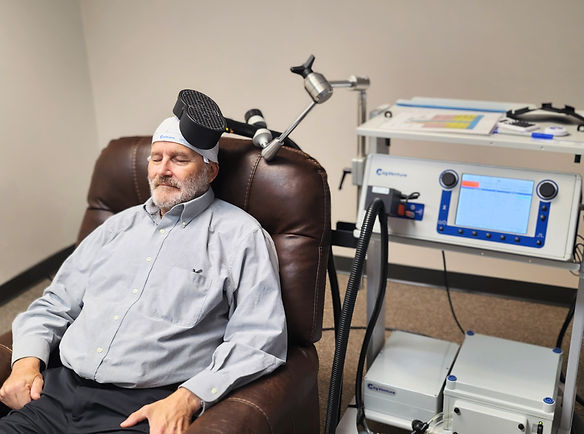
Transcranial Magnetic Stimulation works by delivering targeted stimulation to the areas of the brain that are dysregulated and responsible for the expression of symptoms. TMS is an FDA-approved treatment for refractory Major Depressive Disorder and Obsessive Compulsive Disorder, and it can be used off-label for the treatment of substance use disorder.

Our TMS Protocols
Depression
Insurance Billing Available
-
FDA-Approved
-
3 minute sessions
-
36-40 total sessions
-
5 days per week for up to 8 weeks
Accelerated Depression
FDA-approved and off-label, research-based protocols available.
-
Protocols ranging in length from 1 day to 6 weeks, multiple sessions per day.
-
See additional information about our accelerated protocols and the research supporting them here.
OCD
Insurance Billing Available
-
FDA-Approved
-
18 minute sessions
-
29+ total sessions
-
5 days per week for 6+ weeks
Addiction
Validated and Approved in Europe (3,4)
-
"Off-label" (not FDA approved)
-
12 minute sessions
-
34 total sessions
-
2 sessions per day for 5 days, then 2 sessions per week for 12 weeks
How Does TMS Work?
Clinical Symptoms Arise When the Brain is Dysregulated.
A depressed brain does not operate at full strength in the areas responsible for mood and emotional control. The reduction in activity in these areas means fewer and less healthy communications being sent from the brain to the rest of our nervous system, which is experienced as distorted and negative thought patterns, fatigue, avoidance behaviors, changes in sleep and appetite, and poor motivation. A depressed brain is less able to decode and respond productively to what is happening in the environment. In OCD, we see hyperactivity in a part of the brain called the Anterior Cingulate Cortex, which is responsible for detecting errors and sending signals that help us determine the relative importance of a threat in the environment. In OCD, this overactivity makes it difficulty to let go of internal or external signals that things "aren't right," resulting in an obsessional focus and compulsive behaviors which are intended to address the threat and soothe the self. However, because this is a brain-based problem, the obsessions and compulsions are not solving anything, and in fact lead to more distress and dysfunction over time.
Our TMS Protocols Directly Target the Dysregulated Areas.
TMS is a safe, FDA-approved, non-invasive treatment that uses short magnetic pulses to target the exact areas of the brain affected by depression, OCD, anxious depression, or addictions (off-label). We have extensive data and functional brain studies that have informed the accepted targets and intensities for our protocols. In most cases, we proceed with treatment based on clinical symptoms. However, we do offer QEEG brain mapping for a direct and personalized evaluation of your unique brain signature, which can inform our TMS treatment approach.
Magnetic Pulses Allow for Electrical Change in the Brain.
The TMS magnetic pulse travels through the skull unimpeded to induce neuronal (brain cell) activity. We can adjust the frequency of the stimulus to inhibit (slow down) or stimulate (excite) specific regions of the brain according to our clinical goals. Over time, the repetitive stimulation results in improved cellular metabolism and functioning. Connections improve between the nerve cells and they begin firing properly again, restoring a more balanced set of networks to allow for improved emotional regulation and less distress.

What Does TMS Treatment Look Like?


1. Benefits Inquiry
We can pull your insurance benefits to let you know what coverage you can expect for TMS treatment, before you decide to schedule. We can also discuss financing options to cover out-of-pocket costs.
2. Psychiatric Intake
You will have an initial visit with the psychiatrist to determine whether you are a candidate for treatment and to answer any questions to help you make an informed decision about whether to proceed.
3. What to Expect
You will receive personalized instructions to prepare you for treatment and to optimize your outcome.
-
Treatment does not require sedation.
-
You are able to drive yourself to and from the clinic.
-
Express TMS sessions take only 3 minutes.
4. The First Session
On your first day of treatment we will complete:
-
Brain mapping to identify the precise location of coil placement.
-
Motor threshold (MT) determination to define the appropriate intensity of pulses to be delivered.
-
Your first treatment session, or sessions.
5. Protocol and Follow-Up
We will administer your protocol over the course of days or weeks.
-
We escalate the strength of the pulses based on the protocol and your unique motor threshold.
-
Routine symptom screening tracks your response.
-
We repeat MT determination and, if needed, mapping, to ensure we are on target.
-
You will follow-up with your psychiatrist about midway through the protocol and again once treatment is complete.
What are the Side Effects?
During the treatment you will feel a tapping sensation on your head, which some people describe as uncomfortable. Headaches can occur, which are typically mild and temporary.
Less common side effects include: fatigue, dizziness, tinnitus, nausea, vomiting, insomnia, worsening of anxiety or depression, back or neck pain, migraine aura, odd sensations, or seizures.
Some patients are not candidates for rTMS, due to risk of significant harm with magnetic stimulation:
-
Patients with implanted electronic devices in or near the head (cochlear implants, deep brain stimulators, vagus nerve stimulators, etc.)
-
Patient with other non-removable metal objects in or near the head.
A major benefit of rTMS treatment is that it does not pose a risk of weight gain or sexual side effects, as with many antidepressants.

TMS Team
Clinicians Dr. Kriste Babbitt and Megan Vardeman
TMS Coordinators Melissa Alvarado and Juan Carlos Ortega


Dr. Carla Bejjani is our credentialed, in-network psychiatrist directing treatment for patients using insurance benefits.
Data and References
1) Cole EJ, et al. Stanford Accelerated Intelligent Neuromodulation Therapy for Treatment-Resistant Depression. Am J Psychiatry. 2020 Aug 1;177(8):716-726. doi: 10.1176/appi.ajp.2019.19070720. Epub 2020 Apr 7. PMID: 32252538.
2) Kratter IH, et al. Stanford neuromodulation therapy for treatment-resistant depression: a randomized controlled trial confirming efficacy, and an EEG study providing insight into mechanism of action and a potentially predictive biomarker of efficacy. World Psychiatry. 2026 Feb;25(1):105-116. doi: 10.1002/wps.70032. PMID: 41536095; PMCID: PMC12805067.
3) Madeo G, et al. Long-Term Outcome of Repetitive Transcranial Magnetic Stimulation in a Large Cohort of Patients With Cocaine-Use Disorder: An Observational Study. Front Psychiatry. 2020 Feb 28;11:158. doi: 10.3389/fpsyt.2020.00158. PMID: 32180745; PMCID: PMC7059304.
4) Mehta DD, et al. A systematic review and meta-analysis of neuromodulation therapies for substance use disorders. Neuropsychopharmacology. 2024 Mar;49(4):649-680. doi: 10.1038/s41386-023-01776-0. Epub 2023 Dec 12. PMID: 38086901; PMCID: PMC10876556.
Testimonials

"The amazing ladies who run [this practice] are experienced in a wide array of medicine...this includes promotion of gut health, lab testing to discover sensitivities, balancing diet, etc. What was once considered new age is now essential in our daily health."
-Brian